How to dehydrate fruit at home

How to Make Dried Fruit at Home
Delicious for dressing summer salads and garnishing desserts and baked goods, or great to enjoy as a natural snack, dried fruit is a truly valuable food. Not only for its intense flavor notes, but also for its nutritional contribution to a healthy and balanced diet. Moreover, it is a valid anti-waste alternative, perfect to consume whenever we want and throughout the year. The drying process is very simple and involves removing almost all the water that foods normally contain, so that they can be preserved longer and safely. Let's see how to dehydrate fruit directly at home, and discover all the unique benefits and properties of dried fruit.
Which Types of Fruit to Dehydrate
Before discovering how to dry fruit and which tools to use, it's important to understand which fruits we can safely treat with home dehydration. Considering that this is an entirely natural process that has been widespread since ancient times, almost all fruit varieties can be dried, at the right degree of ripeness. This includes apples, strawberries, apricots, blueberries, blackberries, raspberries, pineapples, cherries, plums, figs, pears, bananas, oranges, and wild berries. As already mentioned, they all need to be dried by removing about 80-90% of the water naturally present inside them.
How to Dry Fruit
Dehydration is one of the oldest and most natural preservation methods. Widely used in farming tradition, it allows fruit—as well as vegetables, aromatic herbs, and some types of greens—to be stored and then eaten in all seasons of the year, even the less fruitful ones. Today, drying fruit is even easier thanks to the tools provided by technology: we won't have to expose it to the sun for days at high temperatures, but simply rely on some of the many small appliances available in the Ariete catalog. Effortlessly and in a short time, we will have plenty of ready-to-eat dried fruit that retains all its organoleptic properties.
Drying Fruit in the Oven
An excellent method for dehydrating fruit is to use an oven, even an electric model. The oven should be set to a constant temperature between 40 and 60 degrees in convection mode—if unavailable, we can always leave the door slightly ajar to achieve the same result. First, cut the previously pitted fruit into very thin slices, and arrange them on a baking sheet covered with parchment paper. Bake and leave in the oven from 4 to 12 hours, depending on the amount of water present in the fruit we have chosen to dry.
Drying Fruit with a Dehydrator
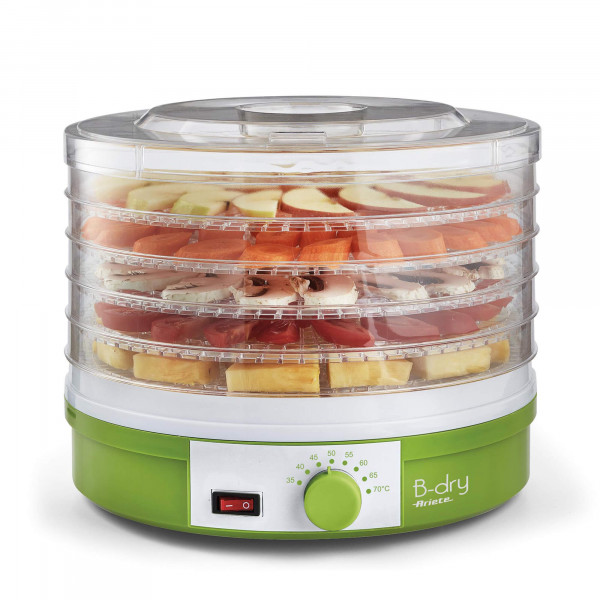
When it comes to dried fruit, however, the electric food dehydrator is the most suitable tool, a precious kitchen ally for those who appreciate this healthy and nutritious delight. Dehydrators like Ariete's B-dry are particularly functional, capable of ensuring water evaporation while simultaneously maintaining the level of minerals and vitamins in the most genuine ingredients. The included 5 interchangeable baskets allow many different foods to be dehydrated simultaneously, for **long-term storage** without the need to add additives and preservatives, combining healthy cooking with flavorful and tasty results. The BPA-free transparent baskets also allow you to monitor the drying progress at any time, while the **adjustable temperature** and **uniform heat distribution** preserve the optimal level of nutrients in the fruit.
Drying Fruit with a Microwave
A third alternative for drying fruit is to opt for a microwave oven. In this case too, it is very simple. We only need to place a sheet of parchment paper inside the microwave. Then, arrange the fruit slices cut very thinly, set the timer for about one minute, and then increase the cooking time by about 30 seconds at a time. This process will need to continue until the fruit is completely dehydrated.
The Benefits of Homemade Dried Fruit
Now that we know how to dry fruit at home, all that remains is to enjoy its benefits. As already mentioned, these are linked to the drying itself, which minimizes the dispersion of the nutritional properties of the foods, preserving their organoleptic properties and without changing their caloric content, as it does not involve the addition of any ingredient. The absence of water also prevents the proliferation of germs and bacteria, resulting in safe-to-snack dried fruit.
With an average of 359 kcal per 100 grams, dehydrated fruit is an excellent source of energy, when consumed in moderation. It is no coincidence that the best nutritionists recommend eating about 30g per day in the morning, to face the day with the right boost. Due to dehydration, for the same weight as fresh fruit, dried fruit contains a higher percentage of fiber, vitamins, and minerals. This is precisely why its consumption brings great benefits to our body, especially regarding the intestinal tract, skin, and bones.






Related Products: